Unlocking Growth with the Shopify Partner Directory
So, what exactly is the Shopify Partner Directory? Think of it as a curated, global marketplace where Shopify store owners can find certified experts—the best developers, designers, and marketers in the game. It’s hands-down the most reliable way to find trusted talent to help you build, tweak, and grow your online store.
Your Gateway to the Shopify Ecosystem
The Shopify Partner Directory is so much more than a simple contact list. It's a living, breathing ecosystem built on real collaboration. For a store owner, it’s a direct line to problem-solvers who can handle anything from a quick theme fix to a massive migration over to Shopify Plus. For agencies and freelancers, it's the single best place to find high-quality clients who are ready to invest in their business.
This directory isn’t just a nice-to-have feature; it’s a core part of what makes Shopify so powerful. It provides the human expertise needed to complement the platform's technology. Let's say you want to build a custom loyalty app or integrate a complicated inventory system. Instead of getting lost in a sea of Google search results, the directory gives you a pre-vetted list of pros who have already been given the stamp of approval by Shopify itself.
Understanding the Two Sides of the Directory
The platform really serves two different groups, but their needs are intertwined, creating a cycle where everyone benefits.
- For Merchants: It’s all about confidence. You can hire experts with a proven track record, read real client reviews, and look through portfolios that show off actual results. This seriously cuts down on the risk of hiring a random agency or freelancer you found online.
- For Partners: It’s a serious lead-generation machine. A sharp, well-built profile is your digital storefront, pulling in the right kind of clients and building your credibility from day one. Getting listed signals a level of trust and skill that merchants are actively looking for.
This two-way relationship is what fuels a lot of the innovation you see on Shopify. And the scale is massive—the directory connects merchants with over 100,000+ certified partners in more than 25 countries. This network is so crucial that Shopify has paid out over $1 billion to its partners, proving the incredible economic impact of this shared success. Many of these partners boast client retention rates as high as 95%, which shows just how valuable these long-term relationships are. You can get the full scoop on this incredible program over on the official Shopify Partners page.
The directory fundamentally bridges the gap between a merchant's vision and the technical or creative expertise needed to bring it to life. It ensures that as your business ambitions grow, you have a reliable network of specialists ready to help you scale.
At the end of the day, getting the hang of the Shopify Partner Directory is a game-changer for both sides. For merchants, it opens the door to talent that can put your growth on the fast track. For partners, it’s the key to building a thriving business on one of the world's top ecommerce platforms. This guide will walk you through the strategies you need to win, no matter which side you’re on.
Finding and Vetting Your Perfect Shopify Partner
Diving into the Shopify Partner Directory can feel a bit like walking into a massive, bustling marketplace. With thousands of certified experts all under one roof, how do you find the one that's just right for your business? The secret isn't just searching—it's searching with a clear plan.
Think of the directory as a sophisticated toolkit, not just a simple list. You wouldn't use a hammer to turn a screw, right? In the same way, you need to use the directory's powerful filters to build a targeted shortlist of potential partners who are a perfect match for your specific project.
Mastering the Directory Search and Filters
That search bar at the top is only the beginning. The real magic happens when you use the advanced filters to slice and dice the database of experts. Don't just type "web developer" and cross your fingers. Get granular.
- Filter by Service: Are you launching a brand-new store from scratch, migrating from a platform like Magento, or in need of a custom app? Start here. This immediately narrows the field to experts who specialize in your exact need.
- Filter by Industry Focus: An agency that's a rockstar for fashion brands might not be the best fit for a B2B industrial supplier. Find partners who already speak your industry's language and get its unique challenges.
- Filter by Location and Language: While great partners can work from anywhere, sometimes you just want someone in your time zone for easier collaboration. This filter is a lifesaver for projects that need a lot of back-and-forth communication.
- Filter by Budget: Let's be real about what you can spend. Filtering by price range makes sure you're only connecting with partners whose rates align with your budget, saving a ton of time for everyone involved.
This is the core idea: merchants use the directory's smart tools to connect with the right partners for the job.
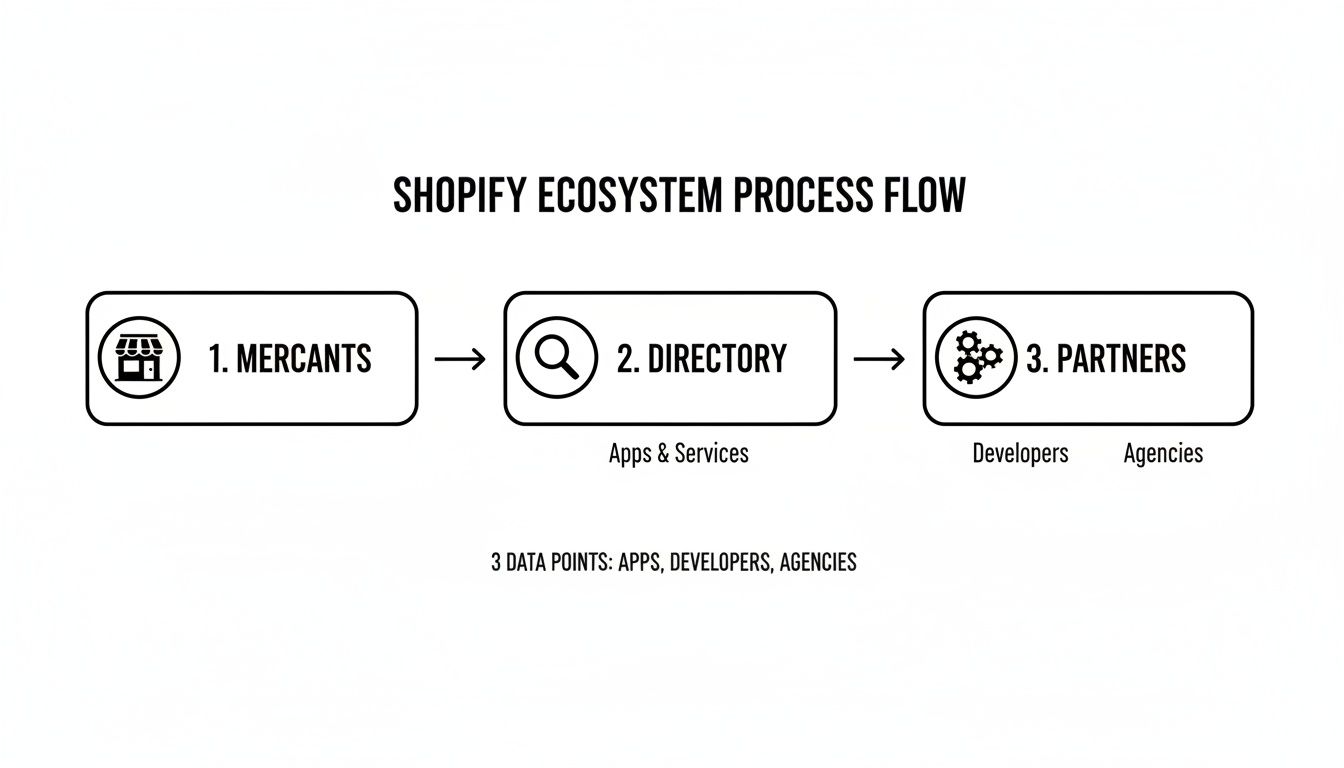
The directory is the bridge that turns a merchant's specific need into a successful, growth-driving partnership.
Analyzing Partner Profiles Like a Pro
Once you've whittled your list down to five to ten potential partners, it’s time to put on your detective hat. An agency's profile page is their digital resume, and it's packed with clues about their quality, reliability, and work style.
Start by carefully reading their "About" section. Does their philosophy and approach click with you? A partner like Zettler Digital, for instance, talks a lot about blending tech with marketing—a fantastic sign if you need a partner who sees the bigger picture.
Next, dive deep into their portfolio. Don't just browse; look for case studies that are directly relevant to your project. If you run a subscription box company, you want to see a partner who has already launched and scaled other subscription businesses. An agency like Kinex Media showcases a wide-ranging portfolio, which can be a great indicator of their adaptability.
Don't just admire the pretty websites in a portfolio. Try to figure out the problem the partner solved. A great case study won't just show the result; it will explain the initial challenge, walk you through the process, and show off measurable results, like a 75% conversion lift or a sevenfold increase in ROI.
Finally, and this is crucial, scrutinize the client reviews. These are pure gold. Look for patterns in the feedback. Do clients consistently rave about their communication, timeliness, and creative problem-solving? Agencies with hundreds of five-star reviews, like C2 Digital or Arctic Grey, have built that reputation for a reason. Pay attention to the substance of the comments, not just the star rating.
Vetting Partners: The All-Important Discovery Call
After all that research, you should have a final list of two or three top contenders. The last step is the discovery call. This is your chance to interview them, but remember, it’s also their chance to interview you. A great partner will ask sharp, insightful questions about your business to make sure it's a good fit for them, too.
Come to the call prepared with your own list of questions. This is where you go beyond their polished profile and get into the nitty-gritty of how they actually work.
To help you get started, here's a quick checklist you can use to vet potential partners during your calls.
Shopify Partner Vetting Checklist
This simple table provides a framework for your discovery calls, ensuring you cover all the critical bases before making a decision.
| Evaluation Area | Key Questions to Ask | What to Look For (Green Flags) |
|---|---|---|
| Project Management | "How do you manage projects and communicate updates? Will I have a single point of contact?" | Clear processes, use of project management tools (like Asana or Monday), and a dedicated project manager. |
| Process & Timeline | "What does a typical timeline look like for a project of this scope? What are the milestones?" | A realistic timeline with defined phases. They should manage your expectations, not just tell you what you want to hear. |
| Measuring Success | "How do you define and measure success for a project like mine? What KPIs do you focus on?" | They ask about your business goals before talking about metrics. They focus on results like revenue, AOV, and LTV. |
| Team Expertise | "Who from your team will be working on my project? What is their experience?" | They can introduce you to the core team members and speak confidently about their specific expertise. |
| Post-Launch | "What kind of support or maintenance do you offer after the project goes live?" | They have clear support packages, retainers, or a plan for ongoing optimization. They see this as a partnership. |
Choosing a Shopify partner is a huge decision for your business. By using a methodical approach—filtering strategically, vetting profiles thoroughly, and asking the right questions—you can move forward with confidence, knowing you’ve found a true partner who is just as invested in your growth as you are.
Optimizing Your Profile to Attract Ideal Clients
For agencies and freelancers on Shopify, your Partner Directory listing isn't just a digital business card—it's arguably your most powerful tool for getting new clients. But just having a profile isn't enough. You have to actively shape it into a magnet for the right kind of leads.
Think of your profile as the front door to your agency. When a brand owner lands on it, every single element—from your bio to your portfolio—needs to convince them that you're the one who can solve their problem. A generic, boilerplate profile just blends into the background, but one that's carefully put together will speak directly to a merchant's pain points and make you the obvious choice.
This isn’t about just checking boxes in the setup. It’s about telling a compelling story that connects with the exact clients you want to work with.
Crafting a Compelling and Client-Focused Bio
Your bio is the first thing a potential client will read, so it has to hit hard and fast. The biggest mistake partners make is talking all about themselves—their history, their team, their mission. Honestly, clients don't care about that at first. They care about their own problems.
So, flip the script. Start by making it crystal clear who you help. Are you the go-to experts for high-growth CPG brands or the specialists in B2B migrations for industrial manufacturers? Your opening lines should make your ideal client think, "Hey, that's us!" It’s the quickest way to make them feel like they've come to the right place.
From there, talk about results, not just services. Instead of saying, "We offer custom theme development," try something like, "We build lightning-fast, custom themes that boost conversion rates and make your brand unforgettable." That small shift connects what you do to a real business outcome, which is all a merchant is really looking for.
Your profile is a filter. Use it to attract merchants who are already looking for your specific skills.
 This is exactly how merchants find you. They use specific keywords and filters, which is why optimizing your profile with the right language is so critical.
Curating a Portfolio That Sells
Your portfolio is where you stop telling and start showing. It’s your proof. A great portfolio doesn't just show off pretty designs; it demonstrates strategic thinking and proves you can deliver measurable success.
- Lead with Your Best Stuff: Pick 3-5 case studies that perfectly represent the kind of work you want more of. If you're chasing Shopify Plus clients, don't bury your best enterprise-level project behind five small theme tweaks. Put it front and center.
- Tell the Whole Story: A powerful case study has a beginning, a middle, and an end. Start with the client's problem, walk through the strategy you developed to solve it, and finish with the cold, hard results.
- Quantify Everything: Numbers are your best friend. Don't just say a project was "successful." Prove it. Did you help a client increase their conversion rate by 75%? Did your marketing work lead to a sevenfold increase in ROI? Concrete data like this builds immediate trust and makes your value undeniable.
"Your portfolio shouldn’t be a gallery of everything you’ve ever done. It should be a curated exhibit of the work you want to do more of. Each project should act as a beacon, attracting the exact type of client you're looking for."
By being selective, your portfolio stops being a simple gallery and starts being a sales tool that works for you 24/7.
Leveraging Social Proof and SEO
The final piece of the puzzle is trust. Positive reviews are the most persuasive tool you have. Make it a part of your offboarding process to ask happy clients for feedback on your directory profile. A constant flow of recent, glowing reviews shows merchants that you're reliable and consistently do great work.
Look at agencies like Arctic Grey, which has over 500 five-star reviews, or C2 Digital, with nearly 700 positive ratings. That level of social proof is overwhelming in the best way. It makes it so much easier for a new client to take a chance on you.
Finally, don't forget the Shopify Partner Directory is a search engine in its own right. To show up when it matters, you have to think about SEO.
- Find Your Keywords: Think like your ideal client. What are they typing into that search bar? They aren't just searching "Shopify developer." They're looking for things like "headless commerce development," "Shopify Plus migration expert," or "Klaviyo automation specialist."
- Sprinkle Them In: Weave these keywords naturally throughout your entire profile—your bio, the service descriptions, and even in the titles and text of your case studies. This is how you start showing up for the most valuable, high-intent searches.
When you combine a client-focused bio, a results-driven portfolio, undeniable social proof, and smart SEO, your Shopify Partner profile transforms from a passive listing into your best client-acquisition channel.
What Can Shopify Partners Actually Do For You?
Jumping into the Shopify Partner Directory can feel a bit like walking into a massive, bustling workshop. You see experts everywhere, but it's not immediately clear who does what. The truth is, these partners offer services that cover every possible need an ecommerce business could have, from the day you sketch your idea on a napkin to the day you're shipping thousands of orders.
Let's break down what they do. Think of the services as falling into a few key areas, each one designed to help you at a different stage of your business journey. Knowing what's available is the first step to finding the perfect expert to help you grow.
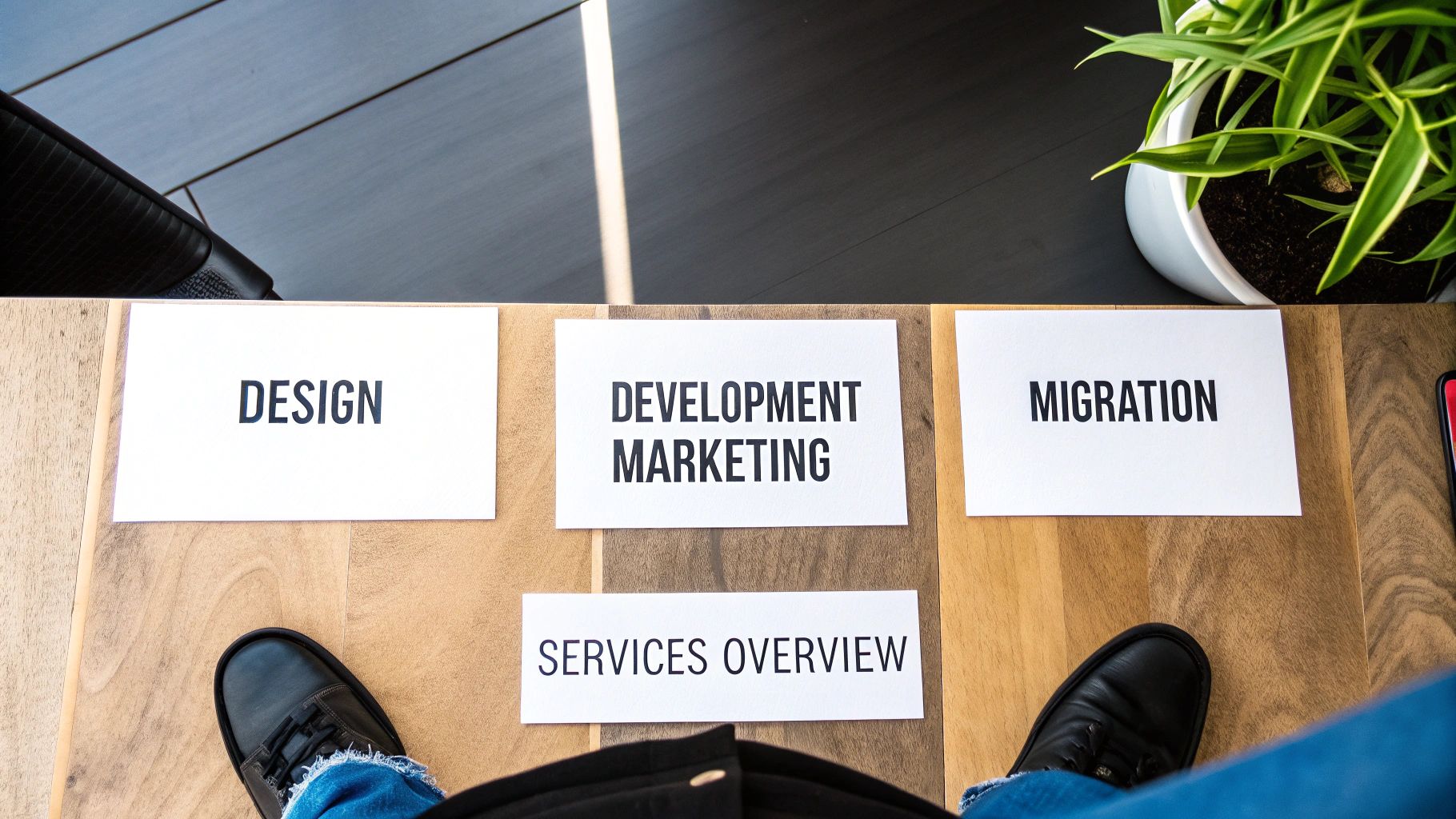
Getting Your Store Off the Ground
This is square one. If you're new to ecommerce, a partner can take your business idea and turn it into a polished, fully functional online store that's ready to make sales. This isn't just about picking a nice-looking theme; they handle the nitty-gritty stuff like payment gateway setup, shipping configurations, and making sure all the technical settings are dialed in for launch.
For businesses already running on another platform, the big challenge is migration. A Shopify Partner can meticulously move your entire store from a platform like Magento or WooCommerce over to Shopify. They make sure all your product data, customer info, and order history comes along for the ride with minimal downtime.
- Real-world example: A local boutique with a loyal following decides it's time to sell online. They hire a partner to build the entire store, from uploading products to setting up the checkout process. This lets the owners focus on what they do best: curating inventory and planning their launch marketing.
Custom Development and Tech Support
Once your store is up and running, you'll eventually want it to do more. This is where development partners come in—they’re the master builders who can create custom solutions to make your store do things you didn't think were possible.
They can build a unique product customizer for your customers, integrate your store with a complex inventory management system, or even create a private app to solve a specific internal problem. They are also the people you call when things break, your site slows down, or you need an expert to troubleshoot a nagging technical glitch.
One of the most powerful things partners do is extend what Shopify can do out of the box. They're the ones building innovative apps that solve real merchant problems, whether that's improving customer reviews or enabling new ways to sell. That constant innovation is what keeps the whole ecosystem humming.
Branding and Visual Design
In ecommerce, your website is your brand. A store that looks unprofessional or is hard to use will send customers running. Partners who specialize in visual design and branding are all about creating a captivating and memorable experience for your shoppers.
They go way beyond just making things look pretty. Their goal is to translate your brand's unique identity into a cohesive digital experience that builds trust and drives sales.
Here’s what they typically handle:
- Custom Theme Design: Crafting a one-of-a-kind storefront that perfectly reflects your brand's personality.
- Branding and Identity: Developing your logo, color scheme, and style guides to ensure a consistent look everywhere.
- Conversion-Focused UX/UI: Designing a user experience that is not only beautiful but also intuitive, making it easy for customers to find what they want and check out.
Driving Sales with Marketing
Building a beautiful store is great, but it doesn't mean much if no one knows it exists. Marketing partners are the specialists who connect you with customers and turn traffic into revenue. Their expertise is vast, covering everything from SEO that gets you found on Google to creating sophisticated email campaigns that bring customers back again and again.
The Shopify Partner Directory itself is a testament to this growth-focused ecosystem. Think about it: over 900,000 Shopify stores use Shop Pay Installments, and more than 500,000 offer local pickup. These are features often implemented and fine-tuned by partners. App partners are also a huge piece of the puzzle—Product Review apps, for example, are installed in 23.8% of all stores to build that crucial social proof.
This partner-driven innovation is a huge factor in Shopify's impressive 10.32% global market share. If you're exploring ways to boost your own sales funnel, many brands find success with affiliate marketing and can benefit from our guide on finding the perfect AI-powered affiliate writing solution. To dig deeper into these numbers, check out these fascinating Shopify statistics on PageFly.
The Real Business Impact of a Great Partnership
Hiring an expert from the Shopify Partner Directory isn't just about outsourcing a task or checking something off your to-do list. Think of it as a strategic investment in your store’s future. The right partner becomes a growth accelerant, turning your brand's potential into real, measurable results you can see in your analytics every single day.
This goes way beyond just getting a prettier website. A solid partnership directly moves the needle on your most important business metrics.
Driving Higher Conversion Rates
A seasoned partner knows that conversion isn't just art—it's a science. They don't just design pages; they engineer customer journeys that smoothly guide a shopper from the moment they land on your site to the final click at checkout. This means digging into site speed, simplifying navigation, and building product pages that inspire trust and a little bit of urgency.
It's often the small things that make a big difference. For instance, an expert might A/B test the color and text of your "Add to Cart" button. A tiny lift in clicks might seem small, but over thousands of visitors, that single change can translate into a significant bump in revenue.
The true value of a Shopify partner isn't just their technical skill, but their ability to connect those skills to real-world business goals. They translate complex code and design principles into increased sales and a healthier bottom line.
Improving Operational Efficiency
Every great ecommerce store is powered by smooth, efficient operations humming along in the background. A certified partner can take a hard look at your current workflows and spot bottlenecks you didn't even know were slowing you down. They can automate tedious tasks, sync your inventory system with your storefront, or build custom reports that give you crystal-clear insights.
- Example: Are you still manually updating inventory levels between your warehouse and your Shopify store? A partner can build an integration that syncs this data automatically, in real-time. This saves you hours of mind-numbing work and prevents those costly overselling mistakes that frustrate customers.
This kind of efficiency boost frees you and your team up to focus on what you do best: developing amazing products, marketing your brand, and building customer relationships.
Boosting Customer Lifetime Value
Getting a new customer is expensive; keeping them is where the real profit is. Partners specializing in marketing and retention can help you build powerful systems to increase customer lifetime value (LTV). They are masters of tools like Klaviyo and can set up automated email and SMS flows that bring past buyers back, suggest products they'll love, and build genuine brand loyalty.
This strategic work turns one-time purchasers into repeat customers—and eventually, into advocates for your brand.
The scale of Shopify's ecosystem is massive, powering around 5.8 million live stores globally. The entire platform is built to help merchants grow, and partners are a critical part of that equation. In the US alone, there are over 2.67 million Shopify stores, and the enterprise-level Shopify Plus is trusted by over 45,000 brands worldwide. This huge network highlights the incredible opportunity waiting for you when you find the right expert through the Shopify Partner Directory. You can dig into more of these fascinating Shopify growth statistics on Charle Agency.
At the end of the day, hiring a professional from the directory is one of the smartest moves a growing merchant can make. It’s not an expense—it’s a direct investment in higher conversions, smoother operations, and strong, sustainable growth.
Answering Your Top Questions
Stepping into the Shopify Partner Directory for the first time can feel a little overwhelming. Let's clear up some of the most common questions that pop up for merchants looking to find the right expert and grow their brand.
What's the Real Cost of Hiring a Shopify Partner?
There’s no single price tag. The cost of hiring a Shopify expert really depends on the size of the job, the partner’s background, and where they're based.
A simple theme adjustment might only run a few hundred dollars, but a full-blown Shopify Plus build or a tricky site migration could easily top $25,000. Most professional agencies will give you a fixed price for the whole project or work on a monthly retainer. The best move is always to chat with at least two or three partners and get detailed quotes before you commit.
What's a Shopify Plus Partner?
Think of Shopify Plus Partners as the platform's elite special forces. These are agencies that Shopify has personally vetted and certified to manage the complex demands of massive, enterprise-level stores.
They’ve got a proven track record with huge projects, custom app integrations, and the kinds of unique problems that high-volume merchants face. While any partner can be fantastic, seeing that "Plus Partner" badge is a signal that you're dealing with a top-tier agency you can trust.
What Happens If a Project Goes Sideways?
If you hit a snag with a partner, the first thing to do is talk it out directly with your project manager. Clear communication solves most problems.
But if things can't be worked out, you're not on your own. You can report the partner straight to Shopify through their official channels. Shopify guards the reputation of the Shopify Partner Directory closely and will investigate any issues to make sure everyone listed meets their high standards.
Key Takeaway: The directory's certification and review process is your safety net. It adds a layer of accountability you just don't get when hiring someone from an open marketplace.
Can I Hire Someone for a Small Job?
Of course. It’s not all about massive site builds. Plenty of agencies and freelancers on the directory are happy to take on smaller, more specific jobs.
You can easily filter your search for services like "Store setup," "Development and troubleshooting," or "Visual branding." This helps you pinpoint experts who specialize in quick fixes or one-off tasks, making it possible for any business, regardless of size, to get professional help.
Ready to unlock massive growth on TikTok Shop? HiveHQ provides the ultimate all-in-one suite to automate your affiliate outreach, track creator performance, and get crystal-clear profit insights. Stop guessing and start scaling with data-driven tools built by ecommerce operators. Discover how HiveHQ can transform your TikTok Shop strategy today.